
14. Abbert, Killaclogher and Carrowmore Boglands.
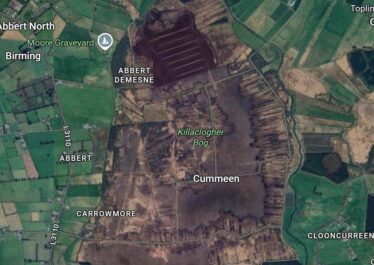
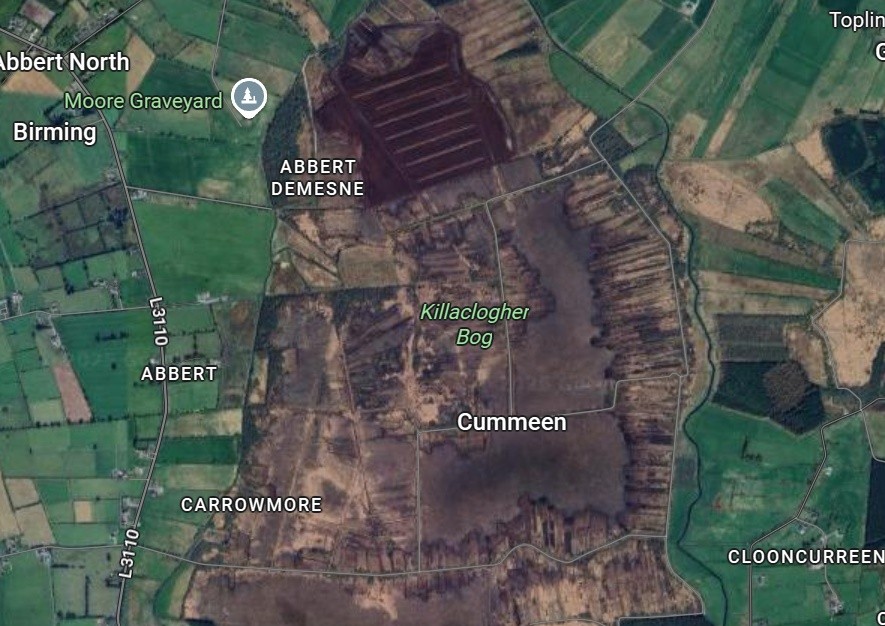
Abbert, Killaclogher and Carrowmore Boglands.
The following article is compiled by the National Parks & Wildlife Service which covers the bogland areas in the townlands Killaclogher, Abbert Demesne and Carrowmore.
SITE NAME: KILLACLOGHER BOG SITE CODE: 001280
Killaclogher Bog NHA is situated about 5 km north-east of Monivea, mainly in the townlands of Abbert Demesne and Carrowmore, in Co. Galway. The site comprises a raised bog that includes both areas of high bog and cutover bog, and an in-filled lake. It is bordered along its eastern side by the Killaclogher River, and on the western side by a small stream. Killaclogher Bog consists of four main lobes, separated from each other by a network of tracks and areas of cutover peat. There are wet areas with some pools in the most southern lobe of the site, but for the most part the bog is uniform with only shallow hollows, which are often filled with algae. A small stream rises at the pool area and flows north-westwards a short distance before it flows into the cutover. Another larger stream exists between the most southern lobe and the one above it, which drains from the bog into the Killaclogher River. A number of interesting flushes occur on the cutover areas at the west of the site. These appear to be linked to the infilled lake to the north. Some of the cutover areas around the bog are still actively cut, but most have been abandoned or reclaimed for agriculture. There are a number of areas of coniferous forestry at the south and north of the site.
The high bog at Killaclogher possesses many of the species typical of Western Raised Bogs in Ireland, with species such as Ling Heather (Calluna vulgaris), Bog Asphodel (Narthecium ossifragum), Carnation Sedge (Carex panicea), many bog mosses (Sphagnum spp.) and the liverwort Pleurozia purpurea. The wettest area occurs in the most southern lobe of the site, where pools and hummock/hollow systems are found in association with wet, spongy bog moss mats. Species found in the pools include the bog moss Sphagnum cuspidatum, Bogbean (Menyanthes trifoliata) and Common Cottongrass (Eriophorum angustifolium). Species such as Cranberry (Vaccinium oxycoccos) and Bog-rosemary (Andromeda polifolia) are frequently found on the hummocks. The remainder of the bog is quite uniform, having been damaged by fire on a number of occasions. The vegetation consists mainly of Ling Heather, Cross-leaved Heath (Erica tetralix), Bog Asphodel, Carnation Sedge, Deergrass (Scirpus cespitosus) and Common Cottongrass. Algal hollows are common and regenerating hummocks of the bog mosses S. capillifolium and S. imbricatum can be found. A number of flushed areas occur on the cutover at the west of the site, which may be linked to the in-filled lake to the north. The site supports an important colony of the Marsh Fritillary butterfly, a species listed on Annex II of the E.U. Habitats Directive.
Current land use on the site consists of peat-cutting around many of the margins of the high bog and along the numerous tracks which cross the site, and the drainage associated with this. Large portions of the bog have been severely burnt in the past. Areas of cutover bog have been reclaimed for agricultural purposes, and a number of areas at the south and north of the site have been planted with coniferous forestry. These activities have resulted in loss of habitat and damage to the hydrological status of the site, and pose a continuing threat to its viability.
Killaclogher Bog NHA is a site of considerable conservation significance comprising as it does a raised bog, a rare habitat in the E.U. and one that is becoming increasingly scarce and under threat in Ireland. Ireland has a high proportion of the total E.U. resource of raised bog (over 50%) and so has a special responsibility for its conservation at an international level.
No Comments
Add a comment about this page