
29. Famine Burial Ground, Esker.
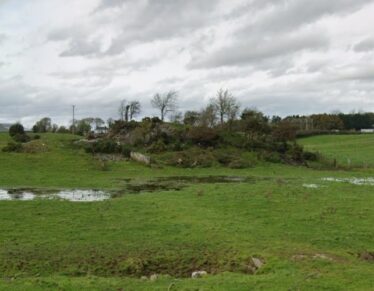
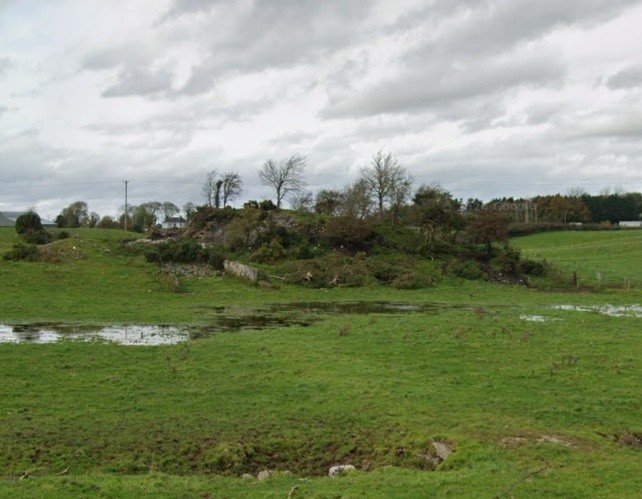
Two highly significant features relating to burial grounds have been recorded by The National Monuments Service and details are contained on their Archaeological Survey Database.
The first of these, GA059-031, is classed as ‘Burial’ which is further defined as “An interment or deposition of human remains in an isolated context, not associated with a burial ground or graveyard. These can date to any period from prehistory onwards.” The findings are further recorded under the following description: “On the highest point of a low esker, c. 125m West of an earthwork (GA059-030). A prominent circular gorse-covered hillock (D c. 100m) has been quarried away at SE and a silage pit is built into the quarried area. According to local information, a great deal of human skulls and bones were uncovered during this work.” This description is derived from the published ‘Archaeological Inventory of County Galway Vol. II – North Galway’. Compiled by Olive Alcock, Kathy de hÓra and Paul Gosling (Dublin: Stationery Office, 1999).
The second recording, GA059-030, is classed as ‘Mound’ which again is further defined as “An artificial elevation of earth or earth and stone of unknown date and function which cannot be classified as any other known archaeological monument type on present evidence.” This finding is further detailed as: “On a low esker ridge. The 3rd edition of Ordnance Survey 6-inch map (1932) shows a small subcircular enclosure (c. 30m by c. 25m) through which a stream appears to flow. Only a slight rise is now visible at the spot, bounded along SW by a small stream. Possibly a barrow or a tumulus. A group of miscellaneous burials (GA059-031) was found c. 125m to West (Note: this refers to the first item listed above)”. This description is derived from the published ‘Archaeological Inventory of County Galway Vol. II – North Galway’. Compiled by Olive Alcock, Kathy de hÓra and Paul Gosling (Dublin: Stationery Office, 1999). This latter recorded item, GA059-030, is located immediately adjacent to the main Monivea to Menlough roadway.
These features serve as a reminder of a most tragic period in the often troubled and turbulent history of our island and resulting from The Great Hunger of the mid-19th century. To be buried in a coffin, in consecrated ground, was a very important sign of human respect in 19th-century Ireland as indeed it remains our most common form today following a passing. However we know that, during The Great Hunger, coffins were not afforded the poor, destitute people interred in this large burial pit. No rosary beads were entwined between their fingers and no care and attention given to their emaciated bodies before burial. This should not be seen as a true reflection of the surviving people but rather a sad, but poignant, reminder of hopeless and impossible situations inflicted on survivors in a destitute population who were themselves faced with most unenviable and difficult decisions.
No Comments
Add a comment about this page